
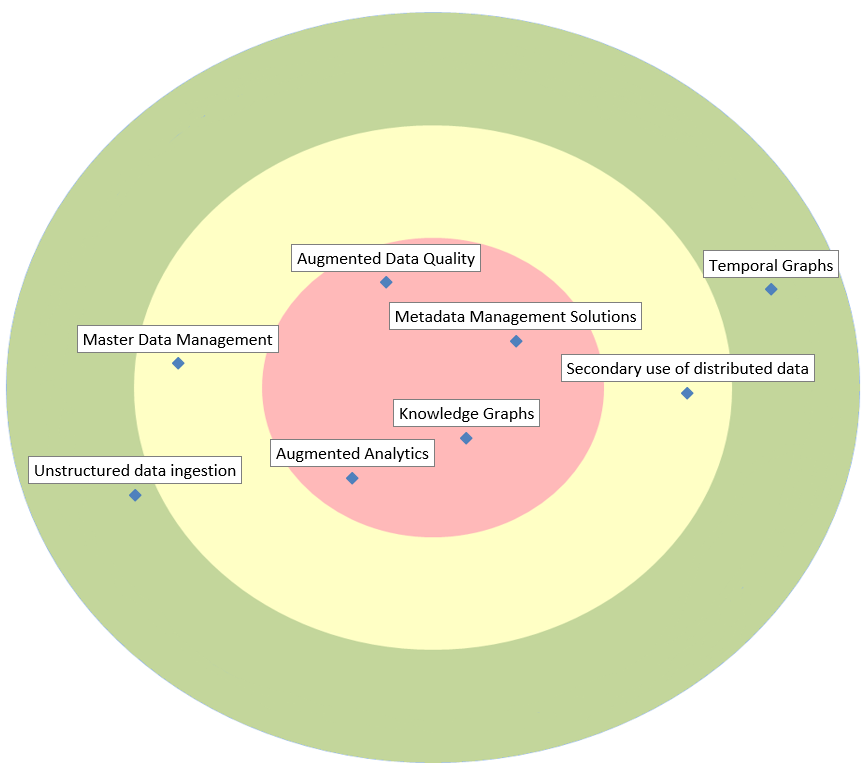
| Metadata Management Solutions | A good data management requires that databases are described with a metadata system (that includes organization, version management, validation workflow, and data quality). In some cases AI can help (active metadata) and there are new open source tools to investigate |
| Knowledge Graphs | Knowledge Graphs relate entities in a meaningful graph structure to facilitate various processes from information retrieval to business analytics. Knowledge graphs typically integrate data from heterogeneous sources such as databases, documents, and even human input. |
| Augmented Analytics | Augmented analytics is the use of enabling technologies such as machine learning and AI to assist with data preparation, insight generation and insight explanation to augment how people explore and analyze data in analytics and business intelligence platforms. |
| Augmented Data Quality | Augmented data quality (ADQ) solutions provide a set of capabilities for improved insight discovery, next-best-action suggestions and process automation by leveraging artificial intelligence/machine learning (AI/ML) features, graph analysis and metadata analytics. |
| Secondary use of distributed data | In order to unlock insights that help researchers or decisions makers, personal data distributed over multiple organizations is required. This secondary use of distributed data should happen efficiently and with respect for the privacy. |
| Master Data Management | Master Data Management (MDM) is a central process for ensuring that an organization’s shared data (like customers or products) is consistent, accurate, and accessible across all systems. It creates a “single source of truth” to improve data quality and decision-making. |
| Temporal Graphs | A temporal graph is a graph that whose structure (nodes and/or edges) changes over time. The analysis of temporal graphs allows us not only to analyze their structure (as with a static graph), but also to take into account how they evolve over time. |
| Unstructured data ingestion | Unstructured data ingestion, or information extraction, allows to extract information from unstructured data (text, video, sounds…) into a structured format that can for instance be used to feed a Knowledge graph. It is not only about ‘entity extraction’, but also about meaningful relationships between those entities. |